



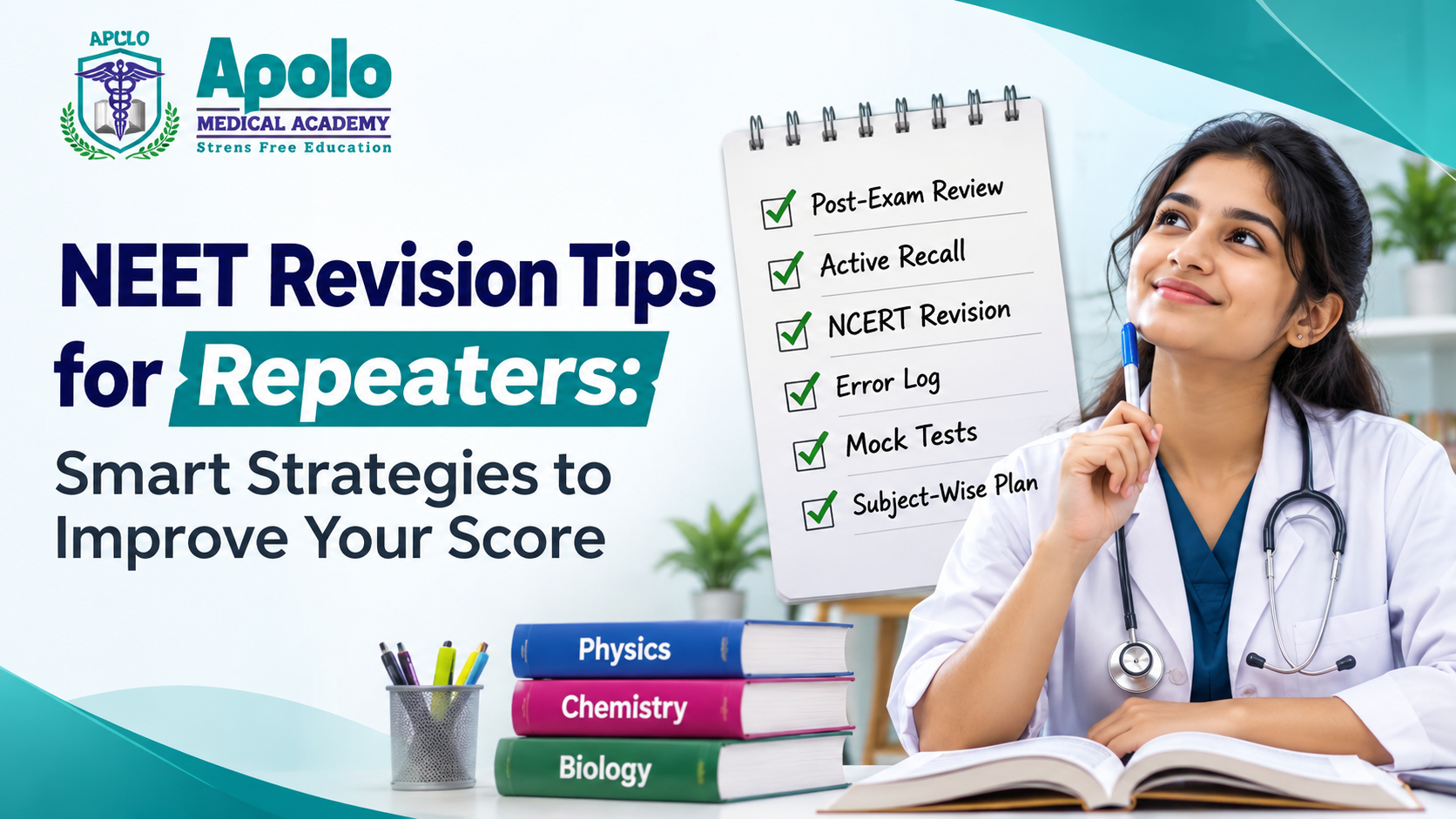
NEET Revision Tips for Repeaters: Smart Strategies to Improve Your Score
Having sat NEET previously, you are aware of the syllabus, exam environment and the difference between knowledge and application. Good NEET Revision Tips for NEET Droppers utilise this knowledge to devise a suitable plan. Rather than re-learning every topic from scratch, analyse your previous NEET results and identify where you lost marks. Then proactively re-learn and assess your development.
1. Conduct a Post-Exam Review
Before devising a revision programme, analyse your previous NEET result and subject performance. Where possible, obtain the official exam answers/answer script.
Place your marking errors into one of four categories – knowledge, memory, application and time management.
By analysing your errors, you can then direct your revision so that you spend more time on areas which need work. For example, you may need to time yourself when working on Physics, and frequently revise Biology memory points. Targeting areas for development ensures your NEET Preparation is both efficient and effective.
2. Structure Revision Around Your Needs
Good NEET Droppers revision comprises concept/revision work, question practice and revision. Time spent on each of these will depend on your individual requirements and should not be dictated solely by someone else’s programme.
Decide on daily subject and chapter revision goals. Include time for inter-subject revision and testing. And re-visit areas that you found challenging in brief periods.
Daily revision could involve Physics question practice, Chemistry concept/reaction revision, Biology NCERT memory work and a quick review of previous errors. Adapt the duration of each element to suit your concentration and lifestyle. Don’t neglect food, exercise and sleep – an unachievable schedule is of little benefit.
3. Use Active Recall
Whilst rereading information can give a sense of understanding, it does not confirm that you can in fact recall information. Active Recall is a good method of assessing your true memory and is therefore a good NEET Revision Strategy.
After reading a section, close your book and either verbally explain, list or answer questions (without referring to your notes) on the information. Only then should you open your book to amend or add to your notes.
For Biology, actively recall definitions, visual information, tables and synonymous words. Chemistry revision should involve re-writing reactions and formulae together with exceptions. For Physics, explain the reasoning behind a formula, state its units and then apply it to a new numerical problem.
Note down information that you commonly struggle to remember. Test yourself daily, then after a few days and a week. Spaced revision ensures older chapters continue to be engaged with.
4. Adopt a Question-Based Approach to NCERT Revision
Although NCERT books should continue to be a key revision resource (especially for Biology and related Chemistry areas), passive reading is insufficient. Instead, utilise a read, question, recall and confirm cycle for each study element.
Refer to the most recent syllabus issued by the National Medical Commission via the official NTA NEET website. Prior to deciding on which chapters to revise, ensure that you are basing your programme on the relevant exam syllabus – not an outdated list.
Read a chapter section and note points that are genuinely unclear. Then, without referencing your notes, attempt multiple choice questions. Analyse why each answer is or is not correct. Later, re-visit and revise any facts that you got wrong.
Rather than having many different books on one subject, it is generally simpler to base your NCERT Revision around one reliable source of information and supplement this with suitable question practice.
5. Maintain an Error Log to Further Develop Skills
Only is a practice exam of value if it leads to modifications in your NEET Revision. Create an error log and note the question/topic, the source of your error, the correct method and the date on which you intend to re-attempt the question.
Do not simply re-produce answers. Instead, write notes that will allow you to independently resolve issues in future. For example, ‘Ensure that you are using the correct sign convention prior to inserting values into equations’.
Analyse your error log bi-weekly. Re-attempt questions having left a suitable period of time has passed. Continually making the same type of error shows that further work is required on the relevant topic or technique.
6. Transition to Whole Exam Practice
Initially, undertake chapter specific testing to further develop weaker areas. As your knowledge develops so too should the variety of tests that you sit – progressing to inter-subject testing. Finally, sit complete NEET Mock Tests in exam-like conditions. Familiarise yourself with the current exam format and, where appropriate, utilise an OMR answer sheet.
Aside from your overall score, analyse your results according to subject, highlighting both the questions that you got wrong and those that you did not attempt. Consider how effectively you managed your time and where preventable errors arose. Also analyse the topics that you regularly found challenging. Comparing test results over a number of weeks will provide a more accurate reflection of your development than a single test result.
Follow this general analysis process:
- Confirm answers that were initially incorrect or uncertain.
- Establish the origin of your errors.
- Revise the relevant topic or fact.
- Re-attempt comparable questions after a brief period.
- Modify next week’s programme in line with your analysis.
If you do not have sufficient time, do not sit practice exams daily as the real value often lies in the subsequent analysis. Typically, a well analysed exam is more valuable than numerous hastily sat papers. Also practise deciding when to abandon a challenging question and only re-visit it if time permits.
7. Adapt Revision Methods for Each Subject
Physics
Develop a strong grasp of basic principles and then work on your speed. Undertake diverse numerical practice. Maintain a list of formulae along with their units and conditions. Become adept at identifying which principle is being assessed in a question. Re-work previously incorrectly answered questions.
Chemistry
Divide your revision into physical, organic and inorganic Chemistry. For physical Chemistry, practice numerical work. For organic Chemistry, revise reasoning and mechanisms where pertinent. For inorganic Chemistry, effectively recall information from NCERT books. Maintain order of reactions and exceptions.
Biology
Combine active recall with NCERT reading. Pay particular attention to visual, labelled, exemplar and precise information. Usually, it is more feasible to engage in brief daily memory work, rather than endeavouring to commit an entire unit to memory.
8. Ensure Continuity and Obtain Advice
Although NEET aspirants may feel compelled to dedicate more time to their studies than others, seldom is this beneficial. Monitor your revision (including chapters, questions and errors) and test analysis. Also maintain regular sleeping patterns and allow yourself time off.
Should your results fail to improve, request that a teacher analyses your error log. Formal NEET tuition and academic advice can also be of value. These may be especially beneficial if you require help with devising a structured programme, clearing doubts or gaining regular test results and/or additional motivation.
Apolo Medical Academy also details its assessment, advice and resources on its website. Select the most appropriate form of assistance for your particular development requirement.
Make Your Next NEET Sitting More Intentional
Although you will not necessarily re-approach your revision in the same manner, successful NEET re-sitting is achieved through making targeted alterations. Review past performance, actively revise, and practise in timed settings. Moreover, use all tests to determine where further development is required. Gradual, progressive developments can be effectively realised by persistently following this approach.
If you are re-sitting NEET, contact Apolo Medical Academy to explore suitable revision strategies, NEET tuition provision and academic advice that corresponds with your present level of preparation.
FAQs
Start by analysing your previous NEET score and identifying the reasons behind lost marks. Create a realistic timetable covering Physics, Chemistry and Biology. Focus on NCERT textbooks, previous-year questions, regular revision and mock examinations. Review mistakes consistently rather than simply increasing study hours.
Students can improve Physics by understanding fundamental concepts, learning formula applications and practising numerical problems regularly. Solving previous years' questions, maintaining an error notebook and analysing mock test performance also help. Consistent practice is more effective than memorising formulas without understanding their applications.
There is no fixed number of hours that guarantees success in NEET. Study time should depend on your preparation level, concentration and remaining syllabus. Focus on completing planned topics, practising questions and revising consistently. Include adequate sleep and short breaks to maintain concentration.
NCERT is a fundamental resource, especially for Biology and relevant Chemistry topics. However, reading textbooks alone is insufficient. Students should combine NCERT revision with numerical practice, conceptual questions, previous-year papers and mock tests to improve their understanding, application skills and examination accuracy.
NEET coaching can benefit repeaters who need structured revision, regular assessments, expert doubt clarification and personalised academic guidance. A suitable institute should identify individual learning gaps, monitor progress and provide opportunities for consistent practice. Students should select coaching based on their specific preparation requirements.